Magna Petra's Non-Destructive Mining: Simulating 4 Billion Years of Solar Wind with AI Digital Twins
Magna Petra's Non-Destructive Mining: Simulating 4 Billion Years of Solar Wind with AI Digital Twins
Moon Mining Deep Dive Series #4
Previous post: Interlune's Prospect Moon: Extracting Helium-3 from Lunar Soil at 1/10 the Energy Next post: The Key to Lunar Base Construction: Regolith 3D Printing and Microwave Sintering
🚀 Opening: Mining Helium-3 Without Digging?
While Interlune digs up lunar soil and Black Moon Energy heats it, one company proposes a completely different approach. Magna Petra claims it can "capture Helium-3 without digging up the soil."
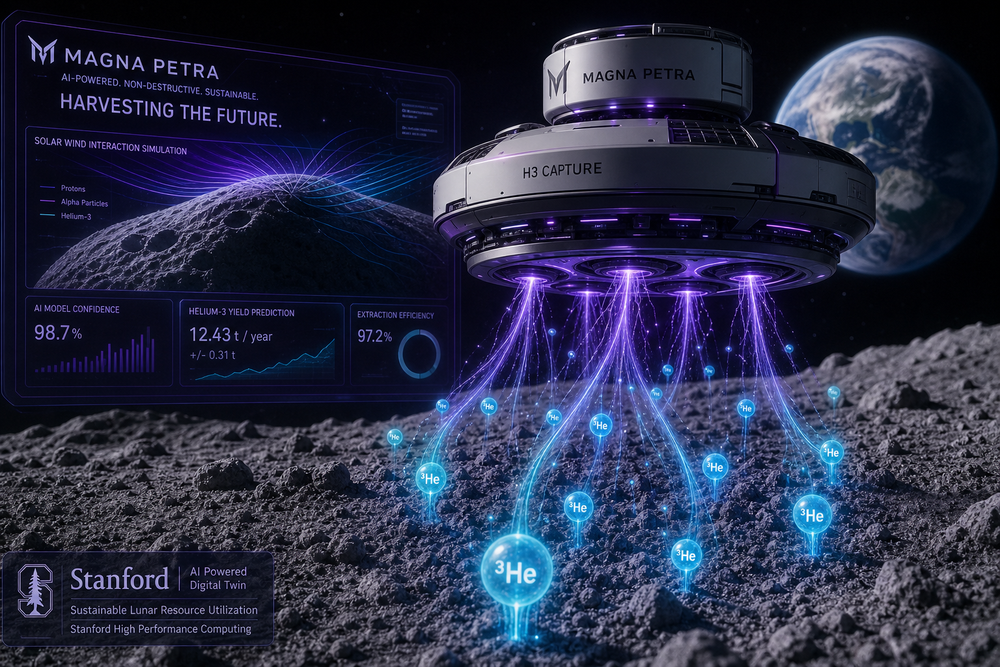
Their weapon is LunarPro™ AI — a digital twin that simulates 4 billion years of solar wind on Stanford's supercomputer. And a unique mechanical device called turbo molecular pumps.
🏢 Magna Petra Company Profile
| Item | Details |
|---|---|
| CEO | Jeffrey Max (veteran startup entrepreneur) |
| Core Technology | LunarPro™ AI + "Sifting & Tilling" non-destructive capture |
| Unique Approach | Capture gaseous He-3 atoms without digging up soil |
| Partners | ispace (Japan), Stanford University |
| Stage | Development phase (early) |
🔬 "Sifting & Tilling" — The Science of Non-Destructive Mining
Why Non-Destructive?
Traditional mining methods excavate large amounts of regolith. This results in: - Massive energy consumption - Lunar surface environment destruction - Enormous waste generation
Magna Petra selectively captures gaseous He-3 atoms from the regolith surface. Like a vacuum cleaner sucking up dust, it leaves the soil intact while capturing only the desired molecules.
Turbo Molecular Pumps
| Characteristic | Description |
|---|---|
| Principle | High-speed rotor blades transfer momentum to gas molecules |
| Method | "Molecular pump" that moves gas through mechanical impact |
| Advantages | No oil/lubricant needed, optimal for vacuum environments |
| Applications | Semiconductor manufacturing, space simulation (repurposed existing technology) |
Turbo Molecular Pump Operating Principle (Simplified)

    He-3 Atom
        ↓
   ┌─────────┐
   │  ╱   ╲  │  ← High-speed rotor blades
   │ ╱  ↑  ╲ │    (tens of thousands RPM)
   │╱   │   ╲│
   └────┼────┘
        ↓
   Pressurized
   Containment
   Vessel
Outgassing Separation
Among the captured gases, He-3 is mixed with He-4, water vapor, and other gases. Magna Petra separates them through an outgassing process.
| Stage | Process | Result |
|---|---|---|
| 1. Capture | Collect gas with turbo pump | Mixed gas |
| 2. Pressurization | Pressurized containment vessel | High-pressure mixed gas |
| 3. Outgassing | Separate through temperature/pressure control | He-3 enrichment |
| 4. Storage | Store purified He-3 | Commercially viable |
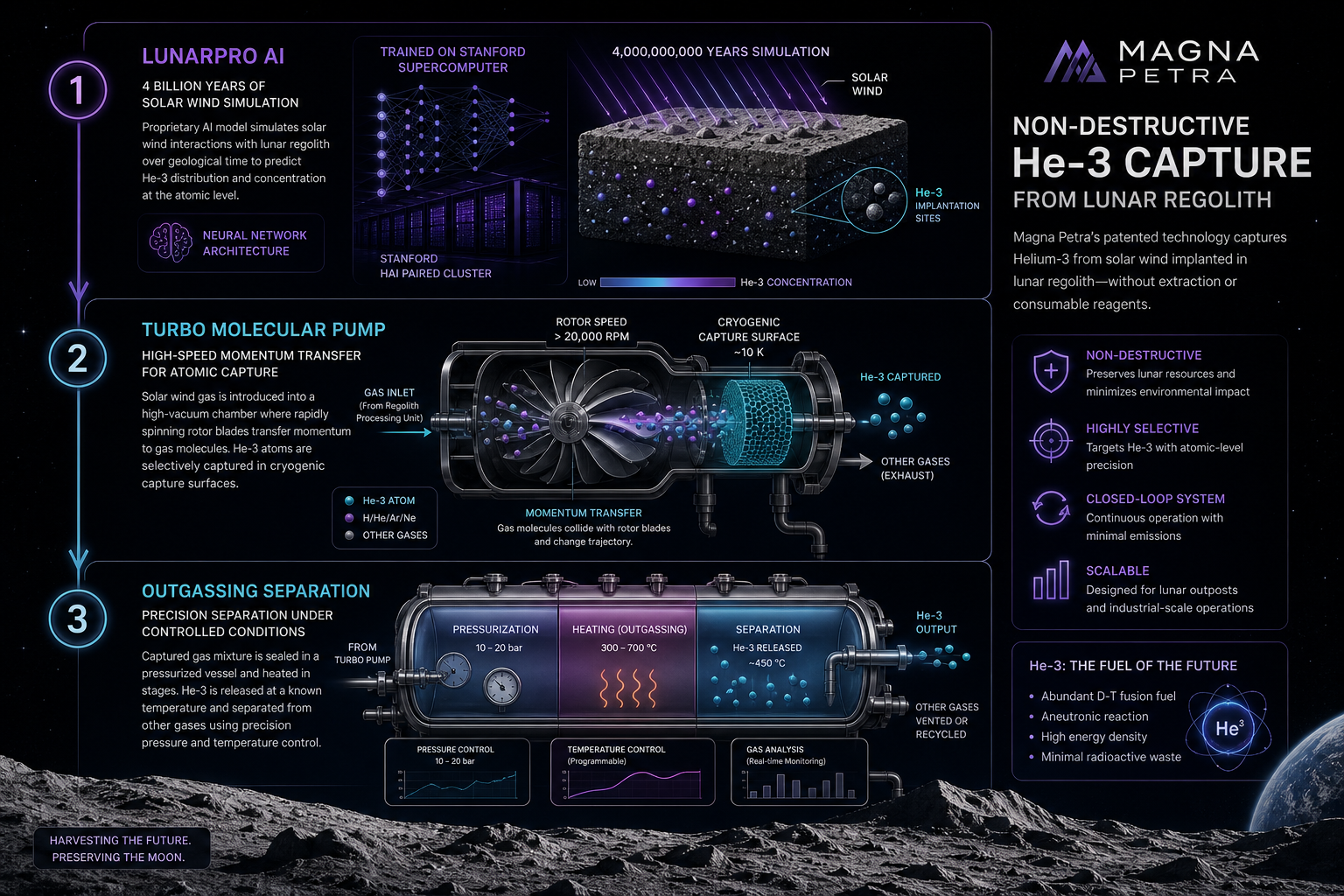 Magna Petra's Non-Destructive He-3 Capture Process: LunarPro™ AI Simulation → Turbo Molecular Pump Gas Capture → Outgassing Separation
🤖 LunarPro™ AI: Simulating 4 Billion Years
Digital Twin Concept
LunarPro™ is a digital replica of the lunar surface. Not just a map, but a simulation engine that retroactively traces the solar wind accumulation process over 4 billion years.
Simulation Scope
| Element | Simulation Content |
|---|---|
| Time | 4 billion years (since Moon formation) |
| Physics | Solar wind particle trajectories, regolith particle interactions |
| Chemistry | He-3 accumulation, diffusion, release dynamics |
| Geology | Crater formation, regolith redistribution |
Stanford Supercomputer
Magna Petra utilizes Stanford University's supercomputing resources. This enables: - High-resolution lunar surface modeling - Trajectory calculations for billions of particles - Improved accuracy in He-3 deposit predictions
2025 Chip-ra Mission
Magna Petra plans to deploy a multispectral chip-ra to the lunar south pole in 2025.
| Purpose | Content |
|---|---|
| Exploration | Precision exploration of He-3 deposits |
| Validation | Compare LunarPro™ AI predictions vs actual data |
| Data | Analyze regolith characteristics through multispectral imaging |
🆚 3-Company Technology Comparison: Magna Petra's Position
Energy Efficiency Spectrum

Black Moon Energy  ████████████████████████████████████████  Thermal (600-900°C)
Interlune          ████                                       Low-temp mechanical
Magna Petra        ██                                         Non-destructive (room temp)
                   ↑
            Decreasing energy consumption
| Comparison Item | Interlune | Black Moon Energy | Magna Petra |
|---|---|---|---|
| Mining Method | Mechanical excavation | Mechanical excavation | Non-destructive capture |
| Processing Temp | Low temp | 600-900°C | Room temp (theoretical) |
| Energy | ~10% | 100% | ~5% (theoretical) |
| Environmental Impact | Medium | High | Minimal |
| Technology Maturity | Validating | Mature | Early |
| Risk | Medium | Low | High |
🎯 Key Data
| Indicator | Value | Source |
|---|---|---|
| Simulation time range | 4 billion years | Magna Petra blog |
| Simulation institution | Stanford University | Magna Petra blog |
| Partner (robotics) | ispace (Japan) | Magna Petra blog |
| 2025 plan | Deploy multispectral chip-ra | Magna Petra blog |
| He-3 concentration (sunlit) | 1.4–15 ppb | Apollo samples |
| He-3 concentration (polar) | ~50 ppb | Lunar Prospector |
🔮 Conclusion: The Most Innovative but Riskiest Bet
Magna Petra is pursuing the most innovative approach among the three companies. The non-destructive method could provide long-term advantages in environmental regulations, and room-temperature capture represents the extreme of energy efficiency.
However, this is also the riskiest bet. The technology has not yet been proven, and the feasibility of turbo molecular pumps operating on the lunar surface needs validation.
The 2025 chip-ra mission will be a crucial watershed moment for validating LunarPro™ AI's prediction accuracy.
In the next post, we analyze regolith 3D printing and microwave sintering — key technologies for lunar base construction.
📚 References
-
Magna Petra — "AI and Robotics in Helium-3 Extraction" https://magnapetra.com/the-role-of-ai-and-robotics-in-helium-3-extraction/
-
ispace — Official Website https://ispace-inc.com/
-
Stanford University — Space Research (Refer to Stanford official website)
-
NASA — Lunar Helium-3 ISRU Paper https://ntrs.nasa.gov/citations/20210022801
Series Guide: - Previous post: Interlune's Prospect Moon: Extracting Helium-3 from Lunar Soil at 1/10 the Energy - Full series list: Moon Mining Tech Blog Series
Written by: lunarpulse_ Published: 2026-05-18 Tags: #moon-mining #magna-petra #helium-3 #AI #digital-twin #space-resources