Magna Petra's Non-Destructive Mining: Simulating 4 Billion Years of Solar Wind with AI Digital Twins
Moon Mining Deep Dive Series #4
🚀 Opening: Mining Helium-3 Without Digging?
While Interlune excavates lunar soil and Black Moon Energy applies heat, one company proposes a fundamentally different approach. Magna Petra claims it can harvest helium-3 without excavating soil at all.
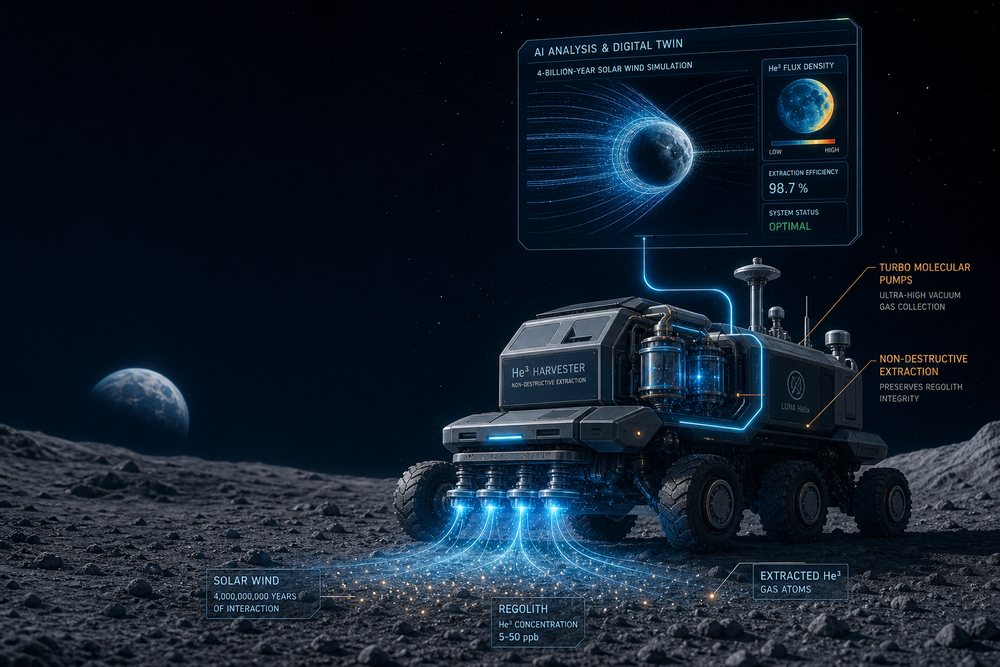
Their weapon is LunarPro™ AI — a digital twin running on Stanford supercomputers that simulates 4 billion years of solar wind. And a unique mechanical device called turbo molecular pumps.
🏢 Magna Petra Company Profile
| CEO | Jeffrey Max (veteran startup entrepreneur) |
| Core Technology | LunarPro™ AI + "Sifting & Tilling" non-destructive harvesting |
| Unique Approach | Harvest gaseous He-3 atoms without excavating soil |
| Partners | ispace (Japan), Stanford University |
| Stage | Development (early stage) |
🔬 "Sifting & Tilling" — The Science of Non-Destructive Mining
Why Non-Destructive?
Traditional mining excavates and processes large volumes of regolith. This means:
- Massive energy consumption
- Lunar surface environment destruction
- Enormous waste generation
Magna Petra selectively harvests gaseous He-3 atoms from the regolith surface. Like a vacuum cleaner sucking up dust, the soil stays in place while only the desired molecules are captured.
Turbo Molecular Pumps
| Principle | High-speed rotor blades transfer momentum to gas molecules |
| Method | "Molecular pump" that moves gas via mechanical impact |
| Advantages | No oil/lubricant needed, optimal for vacuum environments |
| Applications | Semiconductor manufacturing, space simulation (repurposed existing tech) |
Outgassing Separation
The captured gas contains not only He-3 but also He-4, water vapor, and other gases. Magna Petra separates them through an outgassing process.
| Step | Process | Result |
|---|---|---|
| 1. Capture | Collect gas via turbo pump | Mixed gas |
| 2. Pressurize | Pressurized containment vessel | High-pressure mixed gas |
| 3. Outgas | Separate via temperature/pressure control | He-3 concentrate |
| 4. Store | Store purified He-3 | Commercially viable |
🤖 LunarPro™ AI: Simulating 4 Billion Years
The Digital Twin Concept
LunarPro™ is a digital replica of the lunar surface. Not just a map, but a simulation engine that reverse-traces 4 billion years of solar wind accumulation.
Simulation Scope
| Time | 4 billion years (since Moon formation) |
| Physics | Solar wind particle trajectories, regolith particle interactions |
| Chemistry | He-3 accumulation, diffusion, release dynamics |
| Geology | Crater formation, regolith redistribution |
Stanford Supercomputing
Magna Petra leverages Stanford University's supercomputing resources for:
- High-resolution lunar surface modeling
- Trajectory calculations for billions of particles
- Improved He-3 deposit prediction accuracy
2025 ChipSat Mission
Magna Petra plans to deploy a multispectral ChipSat to the lunar south pole in 2025.
| Survey | Precision He-3 deposit mapping |
| Validation | LunarPro™ AI predictions vs actual data comparison |
| Data | Multispectral imaging for regolith characterization |
🆚 3-Company Technology Comparison: Magna Petra's Position
| Metric | Interlune | Black Moon Energy | Magna Petra |
|---|---|---|---|
| Mining Method | Mechanical excavation | Mechanical excavation | Non-destructive harvesting |
| Processing Temp | Low temp | 600-900°C | Room temp (theoretical) |
| Energy | ~10% | 100% | ~5% (theoretical) |
| Environmental Impact | Medium | High | Minimal |
| Tech Maturity | Under validation | Mature | Early stage |
| Risk | Medium | Low | High |
🎯 Key Data
| Indicator | Value | Source |
|---|---|---|
| Simulation Time Range | 4 billion years | Magna Petra |
| Simulation Institution | Stanford University | Magna Petra |
| Partner (Robotics) | ispace (Japan) | Magna Petra |
| 2025 Plan | Deploy multispectral ChipSat | Magna Petra |
| He-3 Concentration (sunlit) | 1.4–15 ppb | Apollo samples |
| He-3 Concentration (polar) | ~50 ppb | Lunar Prospector |
🔮 Conclusion: The Most Innovative but Riskiest Bet
Magna Petra is pursuing the most innovative approach among the three companies. The non-destructive method could provide long-term regulatory advantages, and room-temperature harvesting represents the extreme of energy efficiency.
But this is also the riskiest bet. The technology is unproven, and the feasibility of turbo molecular pumps operating on the lunar surface needs validation.
The 2025 ChipSat mission will be a critical milestone for validating LunarPro™ AI's prediction accuracy.
In the next post, we'll analyze regolith 3D printing and microwave sintering — key technologies for lunar base construction.
Series Navigation:
- Previous: Moon Surface Mining 101: From ISRU to Helium-3
- Next: Regolith 3D Printing and Microwave Sintering (coming soon)
Written by: lunarpulse_
Tags: #moon-mining #magna-petra #helium-3 #AI #digital-twin #space-resources