🚀 Opening: A Hidden Asset in the Moon's Darkest Places
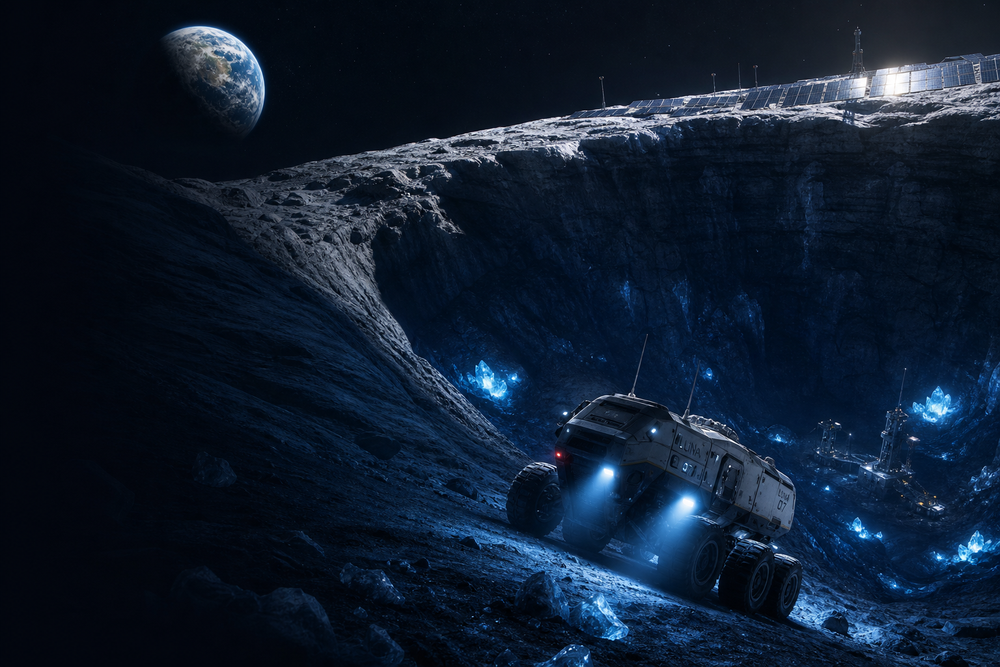
At the Moon's south pole, there are places where sunlight never reaches. The floors of ancient craters, trapped in eternal shadow — these are called PSRs (Permanently Shadowed Regions).
And in these dark places lies water ice. Hundreds of millions of tons of it. This water is the lifeline for lunar bases and the "gas station" for rockets bound for Mars.
🌑 What Are PSRs?
Formation
Element
Description
Location
Floors of craters at lunar poles
Angle
Sunlight incidence angle < crater wall slope
Temperature
-250°C to -150°C (near absolute zero)
Characteristic
No sunlight for billions of years
Major PSR Regions
Region
Location
Feature
Shackleton Crater
90°S
Near south pole, solar power accessible from rim
Cabeus Crater
South Pole
LCROSS impact site, water vapor confirmed
Amundsen Crater
South Pole
Large PSR area
Faustini Crater
South Pole
Adjacent to Shackleton
💧 Water Ice: Presence and Quantity
Discovery Timeline
Year
Mission
Discovery
1998
Lunar Prospector
Hydrogen signals (ice possible)
2009
LCROSS
Water vapor directly confirmed after impact
2010+
LRO (Lunar Reconnaissance Orbiter)
Detailed PSR mapping
Estimated Water Ice
Metric
Value
Source
South Pole PSR water ice
600 million tons
LRO data
Concentration
0.5-5% by mass
LCROSS analysis
Distribution
Uneven across crater floors
Exploration results
Forms of Water
Form
Description
Mining Difficulty
Ice crystals
Ice between regolith particles
Medium
Soil-ice mixture
Mixed with regolith
High
Surface ice
On crater floor surface
Low (initial target)
💰 Economic Analysis
Earth Transport vs Local Production
Item
Earth Transport
Local Production (PSR)
Cost/kg
~$10,000–100,000
~$100–1,000 (estimated)
Energy
Chemical propellant
Solar/nuclear
Risk
Launch failure, debris
Immature technology
Scalability
Limited
Near-unlimited
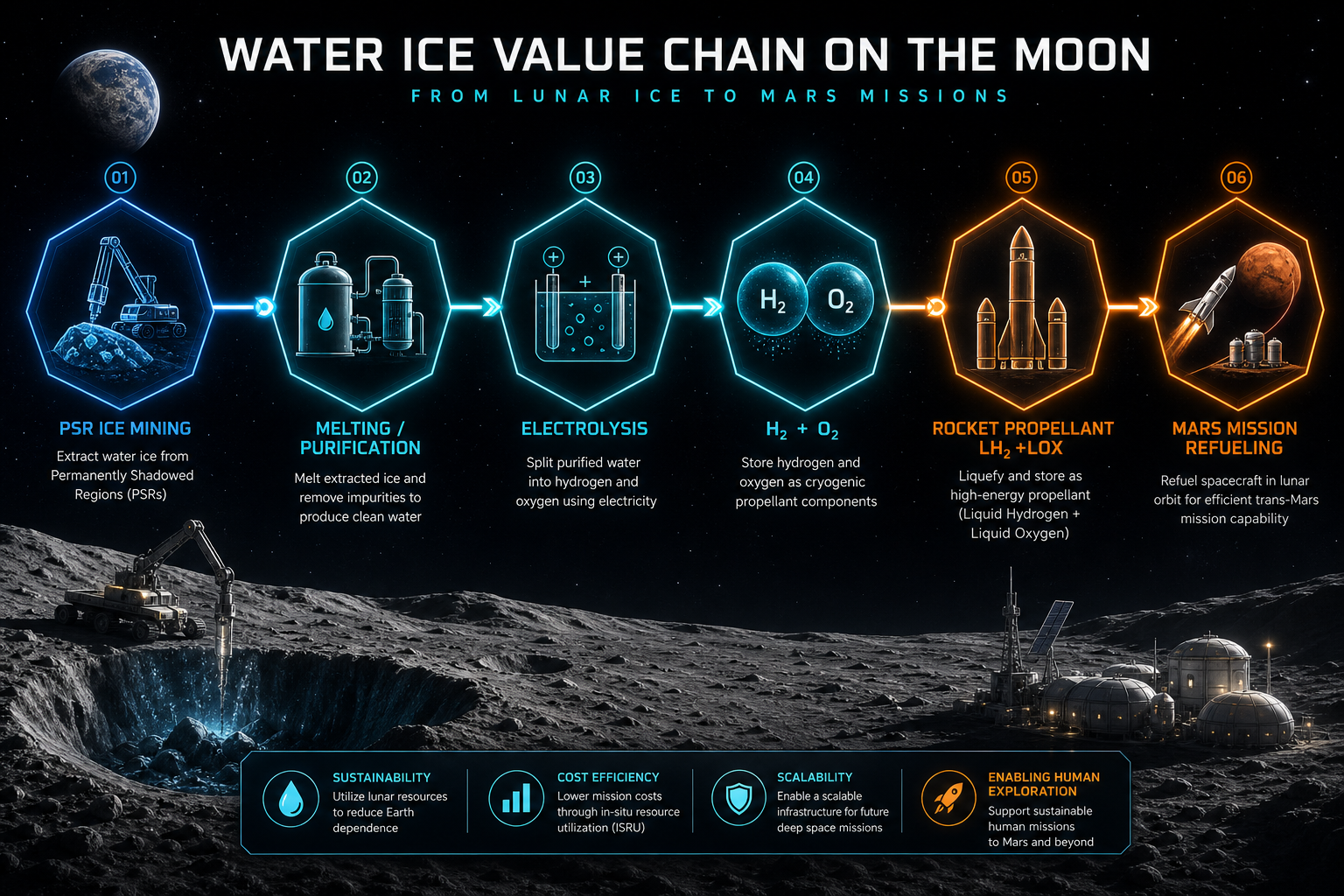
Water Ice Value Chain
The value chain from PSR ice mining to rocket propellant refueling for Mars missions
Revenue Model
Revenue Source
Unit Price (est.)
Market
Water (life support)
$100-500/kg
Lunar bases
Oxygen (breathing)
$200-1,000/kg
Lunar bases
Hydrogen/Oxygen (propellant)
$50-300/kg
Orbiters/Mars ships
Total
$350-1,800/kg
🏗️ Mining Technologies
Current Technology Readiness
Technology
Principle
Status
Mechanical mining
Drill/scoop ice collection
Under validation
Thermal extraction
Heat and collect vapor
Lab success
Optical mining
Intense light vaporizes ice
Concept stage
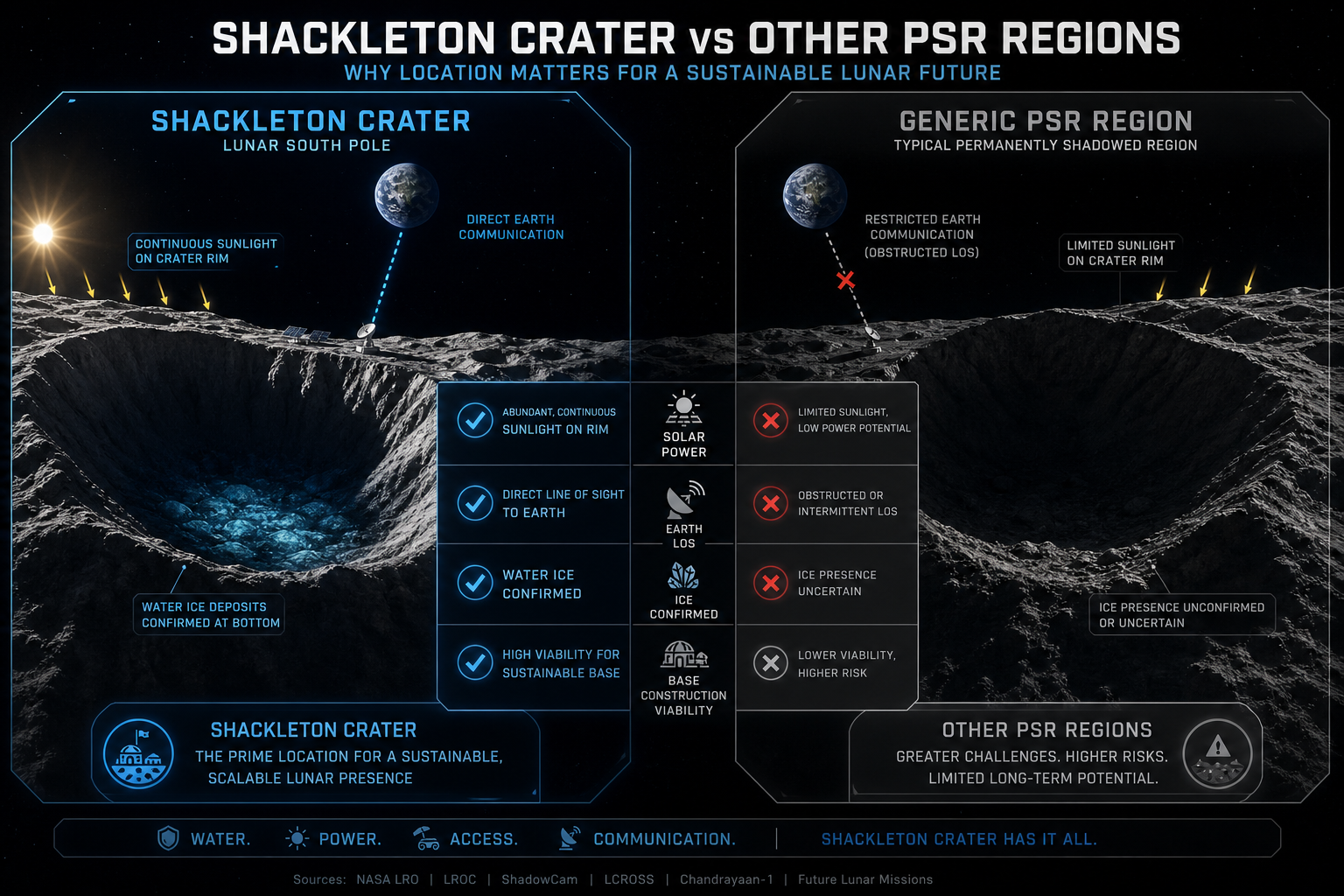
Shackleton Crater: The Optimal Mining Site?
Shackleton Crater is unique among PSRs for its continuous solar power access from the rim and direct Earth line-of-sight communication
Feature
Shackleton Crater
Generic PSR
Location
Near south pole
Various south pole
Solar power
Continuous from rim
Limited
Communication
Direct Earth LOS
Limited
Water presence
Confirmed
Confirmed
Base construction
Solar power on rim
Difficult
⚠️ Challenges
Technical Challenges
Challenge
Description
Solution Direction
Extreme cold
-250°C equipment operation
Heating systems, cryogenic materials
Vacuum
Lubricant evaporation
Solid lubricants, magnetic levitation
Dust
Electrostatic adhesion
Shielding, ionization
Communication delay
Earth-Moon 1.3 seconds
Autonomous systems
Economic Challenges
Challenge
Description
Solution Direction
Initial investment
Billions of dollars
Government-private partnerships
Uncertain demand
Immature market
Long-term contracts
Competition
Declining Earth transport costs
Technology innovation
🎯 Key Data
Indicator
Value
Source
South Pole PSR water ice estimate
600 million tons
LRO
Water ice concentration
0.5-5%
LCROSS
PSR temperature
-250°C to -150°C
LRO Diviner
Earth transport cost
~$10,000-100,000/kg
Falcon Heavy
Local production cost (est.)
~$100-1,000/kg
Industry estimates
Water value (life support)
$100-500/kg
Estimated
Propellant value
$50-300/kg
Estimated
🔮 Closing: Water Is the Moon's "Crude Oil"
Water ice in PSRs is the "crude oil" of the lunar economy. Just as petroleum drove the Industrial Revolution, lunar water will drive the space economy of the 21st century.
Shackleton Crater could be at its center — the only place where sunlight, water, and communication converge.
In the next post, we analyze the robots that will dig the Moon — autonomous excavation robotics from NASA's RASSOR to Interlune's 100-ton/hour excavators.
📚 References
NASA — Lunar Reconnaissance Orbiter (LRO) https://www.nasa.gov/lro
NASA — LCROSS Mission https://www.nasa.gov/lcross
NASA — Artemis Base Camp https://www.nasa.gov/artemis
Science — "Water on the Moon" (LCROSS results paper)