Interlune's Prospect Moon: Extracting Helium-3 from Lunar Soil at 1/10 the Energy
Interlune's Prospect Moon: Extracting Helium-3 from Lunar Soil at 1/10 the Energy
Moon Mining Deep Dive Series #3
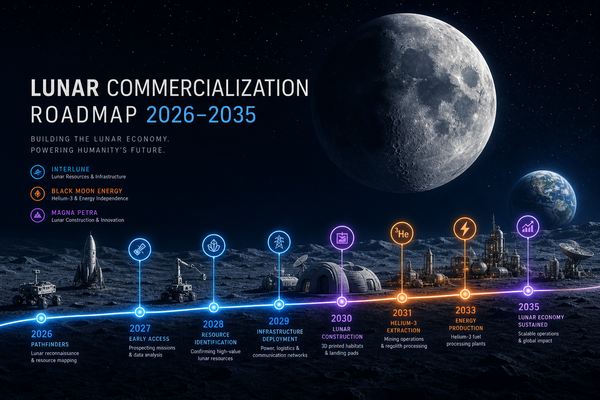
Previous post: Helium-3 Extraction: Interlune vs Black Moon Energy vs Magna Petra Next post: Magna Petra's Non-Destructive Mining: Simulating 4 Billion Years of Solar Wind with AI Digital Twins
🚀 Opening: Blue Origin Alumni Digging on the Moon
In 2020, former Blue Origin President Rob Meyerson and former Chief Architect Gary Lai founded a startup with Apollo 17 astronaut Harrison Schmitt. The name: Interlune. Their goal is clear — commercialize the technology for extracting Helium-3 from lunar regolith.
In 2025, Interlune received a $6.9M sole-source contract from NASA. The contract: "Prospect Moon". In 2028, this payload heads to the Moon.
🏢 Interlune Company Profile
| Item | Details |
|---|---|
| Founded | 2020 |
| Headquarters | Seattle, USA |
| Founders | Rob Meyerson (former Blue Origin President), Gary Lai (former Blue Origin Chief Architect), Harrison Schmitt (Apollo 17 astronaut), Indra Hornsby |
| Core Technology | Prospect Moon payload (4-stage extraction process) |
| NASA Contract | $6.9M (18 months, sole-source) |
| Launch Target | 2028 |
Why Sole-Source?
NASA selected Interlune without competitive bidding because of the uniqueness of their technology. Interlune's low-energy mechanical extraction approach is fundamentally different from conventional thermal-based ISRU.
🔬 4-Stage Extraction Process: Excavate → Sort → Extract → Separate
Interlune's core IP is the 4-stage process. Here's a detailed analysis of each stage.
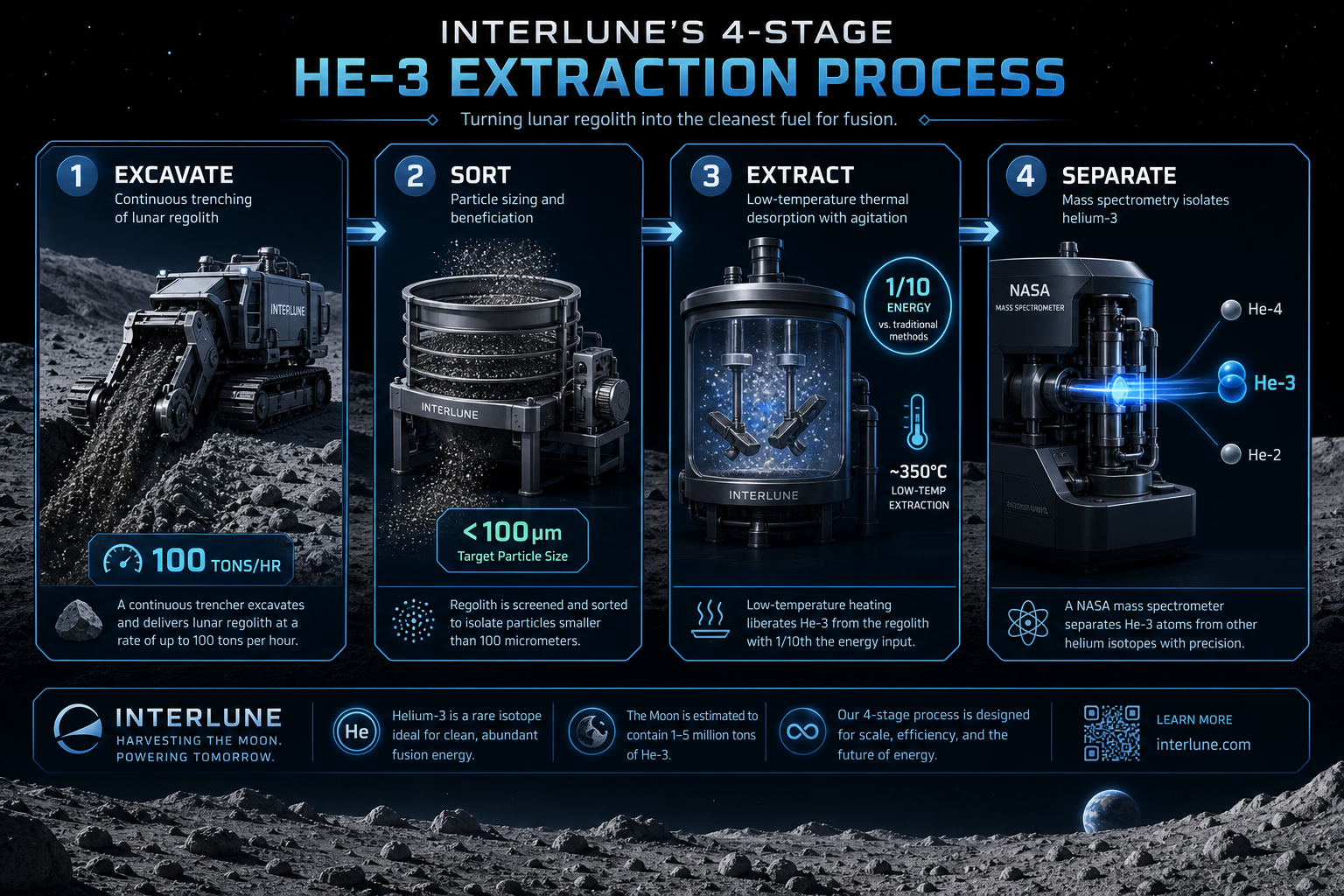 Interlune's 4-Stage He-3 Extraction Process: Excavate → Sort → Extract → Separate
Stage 1: Excavate
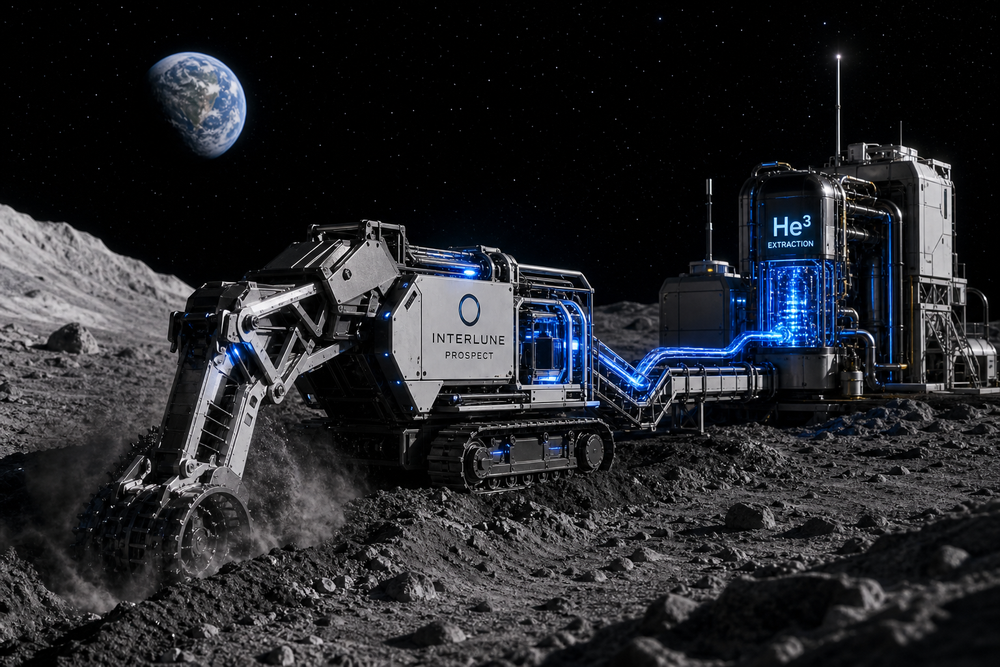
Equipment: Continuous trencher-type excavator developed in collaboration with Vermeer Corporation
| Specification | Value |
|---|---|
| Throughput | 100 metric tons of regolith per hour |
| Method | Continuous trenching |
| Feature | Based on commercial heavy equipment technology |
Prototype Reveal: May 7, 2025 — Full-scale prototype unveiled - Vermeer Corporation manufactures large-scale earthmoving equipment on Earth - Design optimized for lunar gravity (1/6g) environment
Stage 2: Sort
Principle: Particle-size sorting device
Key Insight: <100μm particles have higher He-3 concentration.
| Particle Size | He-3 Concentration Characteristics |
|---|---|
| <100μm | Optimal — High He-3 concentration |
| 100μm ~ 1mm | Medium |
| >1mm | Low |
Test History: - Tested 4+ times on Zero Gravity Corp's parabolic flights - August 2024: Sorting prototype test - 40 dives, 2.5 hours simulating lunar gravity (1/6g) environment
Stage 3: Extract — The Core Innovation
Method: Mechanical processing (agitation/crushing) + low-temperature heating
Innovation: 1/10 energy consumption compared to conventional 600-900°C thermal extraction
| Method | Temperature | Energy | Company |
|---|---|---|---|
| Traditional thermal extraction | 600-900°C | 100% | Black Moon Energy |
| Interlune method | Low temp | ~10% | Interlune |
Mechanism (Estimated): 1. Mechanical vibration/compression releases He-3 from regolith 2. Minimal temperature rise (likely below 200°C) 3. Gaseous He-3 collection
Exact temperature and mechanism are trade secrets. Additional information is expected from NASA contract public documents.
Stage 4: Separate
Equipment: NASA-developed mass spectrometer
Method: Mass analysis to separate He-3 from other gases
Payload Components: - Robotic arm - Scoop - Particle-size sorting device - Mass spectrometer (NASA-provided) - Mechanical + thermal processing units
🤝 Key Partnerships
| Partner | Role | Status |
|---|---|---|
| NASA | Prospect Moon payload contract ($6.9M), mass spectrometer provision | ✅ Contract signed |
| Vermeer Corporation | Excavator prototype development | ✅ Revealed May 2025 |
| Astrolab | Autonomous mobility/harvesting fleet | ✅ Partnership active |
| Zero Gravity Corp | Parabolic flight testing | ✅ 4+ tests completed |
Significance of Astrolab Partnership
Astrolab develops lunar surface vehicles (rovers). While Interlune's excavator operates at fixed mining sites, Astrolab's rovers can handle transportation between mining sites and harvested material transport.
💼 Customers & Market
Secured Customers
| Customer | Use Case | Contract Date | Historical Significance |
|---|---|---|---|
| U.S. DOE Isotope Program | Government research/medical isotopes | 2025 | First non-Earth resource government purchase |
| Maybell Quantum | Quantum refrigeration | 2025 | First commercial customer, delivery from 2029 |
He-3 Market Value
| Indicator | Value |
|---|---|
| He-3 estimated value | ~$20M+/kg |
| 3L He-3 processing volume | Swimming pool-sized regolith |
| Market size (2030 estimate) | Billions of dollars (if fusion commercialized) |
🔬 Interlune Research Lab (IRL)
- Location: Houston
- Role: Development of thermal control systems
- Purpose: Thermal management optimization for Prospect Moon payload
- Significance: Equipment protection under extreme lunar temperature variations (-173°C ~ 127°C)
📈 Prospect Moon Roadmap
2025 ── Excavator prototype reveal, customer contracts signed
       └── Zero-G testing continues

2026 ── Payload detailed design, NASA review
       └── IRL thermal control system development

2027 ── Payload assembly, integration testing
       └── Launch preparation

2028 ── 🚀 Prospect Moon launch
       └── Lunar surface He-3 extraction demonstration

2029 ── Commercialization begins (Maybell Quantum delivery)
       └── Additional customer acquisition
🎯 Key Data Summary
| Indicator | Value | Source |
|---|---|---|
| NASA contract amount | $6.9M (18 months) | SpaceNews |
| Prospect Moon launch target | 2028 | NASA contract |
| Excavator throughput | 100 metric tons/hour | Press Release |
| Energy efficiency | 10× reduction vs conventional | Interlune claim |
| He-3 value | ~$20M+/kg | Interlune blog |
| Patent | US20240200447A1 | Google Patents |
| Zero-G test count | 4+ | Interlune blog |
| Parabolic flight dives | 40 dives/2.5 hours | Interlune blog |
🔮 Conclusion: Can Interlune Become the Tesla of Lunar Mining?
Interlune has the perfect combination of technology innovation + strong team + NASA support + early customers. Blue Origin alumni's space industry network, Vermeer's heavy equipment manufacturing capabilities, and NASA's technical support make it a unique company.
The success of Prospect Moon in 2028 will be the watershed moment for the He-3 extraction industry. If successful, Interlune could become the "Tesla" of lunar mining.
In the next post, we analyze Magna Petra's AI-based non-destructive mining technology — the most innovative approach in the field.
📚 References
-
Interlune — "Excavate, Sort, Extract, and Separate" (Core IP Blog) https://www.interlune.space/blog/excavate-sort-extract-and-separate-interlune-core-intellectual-property
-
Interlune — "Space Resources Company Interlune Unveils Full-Scale Prototype" https://www.interlune.space/press-release/space-resources-company-interlune-unveils-full-scale-prototype
-
Interlune — "Interlune Awarded $6.9 Million Contract from NASA" https://www.interlune.space/press-release/interlune-awarded-6-9-million-contract-from-nasa-for-lunar-resource-development
-
SpaceNews — "Interlune wins NASA contract for helium-3 extraction payload" https://spacenews.com/interlune-wins-nasa-contract-for-helium-3-extraction-payload/
-
NASA Patent — US20240200447A1 (Lunar Regolith Processing System) https://patents.google.com/patent/US20240200447A1
Series Guide: - Previous post: Helium-3 Extraction: Interlune vs Black Moon Energy vs Magna Petra - Full series list: Moon Mining Tech Blog Series
Written by: lunarpulse_ Published: 2026-05-18 Tags: #moon-mining #interlune #prospect-moon #helium-3 #nasa #space-resources