Helium-3 Extraction: Interlune vs Black Moon Energy vs Magna Petra
Helium-3 Extraction: Interlune vs Black Moon Energy vs Magna Petra
Moon Mining Deep Dive Series #2
Previous post: Moon Surface Mining 101: From ISRU to Helium-3 Next post: Interlune's Prospect Moon: Extracting Helium-3 from Lunar Soil at 1/10 the Energy
🚀 Opening: 3 Companies Competing for the Moon's "Dream Fuel"
The lunar regolith holds a secret weapon accumulated over 4 billion years of solar wind — Helium-3 (He-3). An aneutronic fusion fuel that produces almost no neutrons, it is virtually nonexistent on Earth but exists in hundreds of thousands of tons on the Moon.
As of 2026, three pioneering companies are entering He-3 mining through different technological paths. This post provides an in-depth comparison of their technologies, energy efficiency, and commercialization roadmaps.
📊 3-Company Technology Comparison Summary
| Company | Core Technology | Extraction Method | Energy Consumption | Stage | NASA/Partners |
|---|---|---|---|---|---|
| Interlune | Prospect Moon Payload | Mechanical processing + low-temp heating | 1/10 of conventional | Tech validation (2028) | NASA $6.9M, Vermeer, Astrolab |
| Black Moon Energy | Robot scouting + compression storage | Robot mining + gas compression (600-900°C) | Standard thermal-based | Exploration phase (2029) | JPL, DOE |
| Magna Petra | LunarPro™ AI + "Sifting/Tilling" | Non-destructive mechanical capture | Low energy (theoretical) | Development phase | ispace (Japan) |
1️⃣ Interlune — Mechanical Innovation
Company Overview
- Founded: 2020, Seattle
- Founders: Rob Meyerson (former Blue Origin President), Gary Lai (former Blue Origin Chief Architect), Harrison Schmitt (Apollo 17 astronaut)
- Vision: Demonstrate He-3 extraction technology with "Prospect Moon" payload
Core Technology: 4-Step Process
Excavate → Sort → Extract → Separate
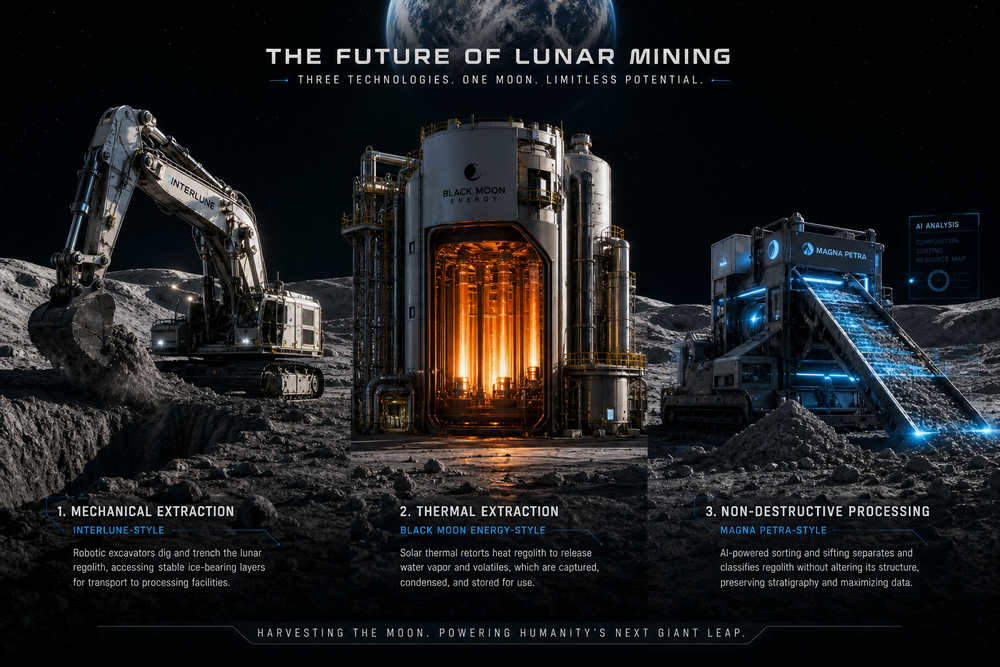
- Excavate: Continuous trencher-type excavator developed with Vermeer Corporation processes 100 tons per hour
- Sort: Particle selection <100μm (He-3 concentration optimization)
- Extract: Mechanical processing + low-temperature heating → 1/10 energy of conventional methods
- Separate: NASA-developed mass spectrometer for He-3 separation
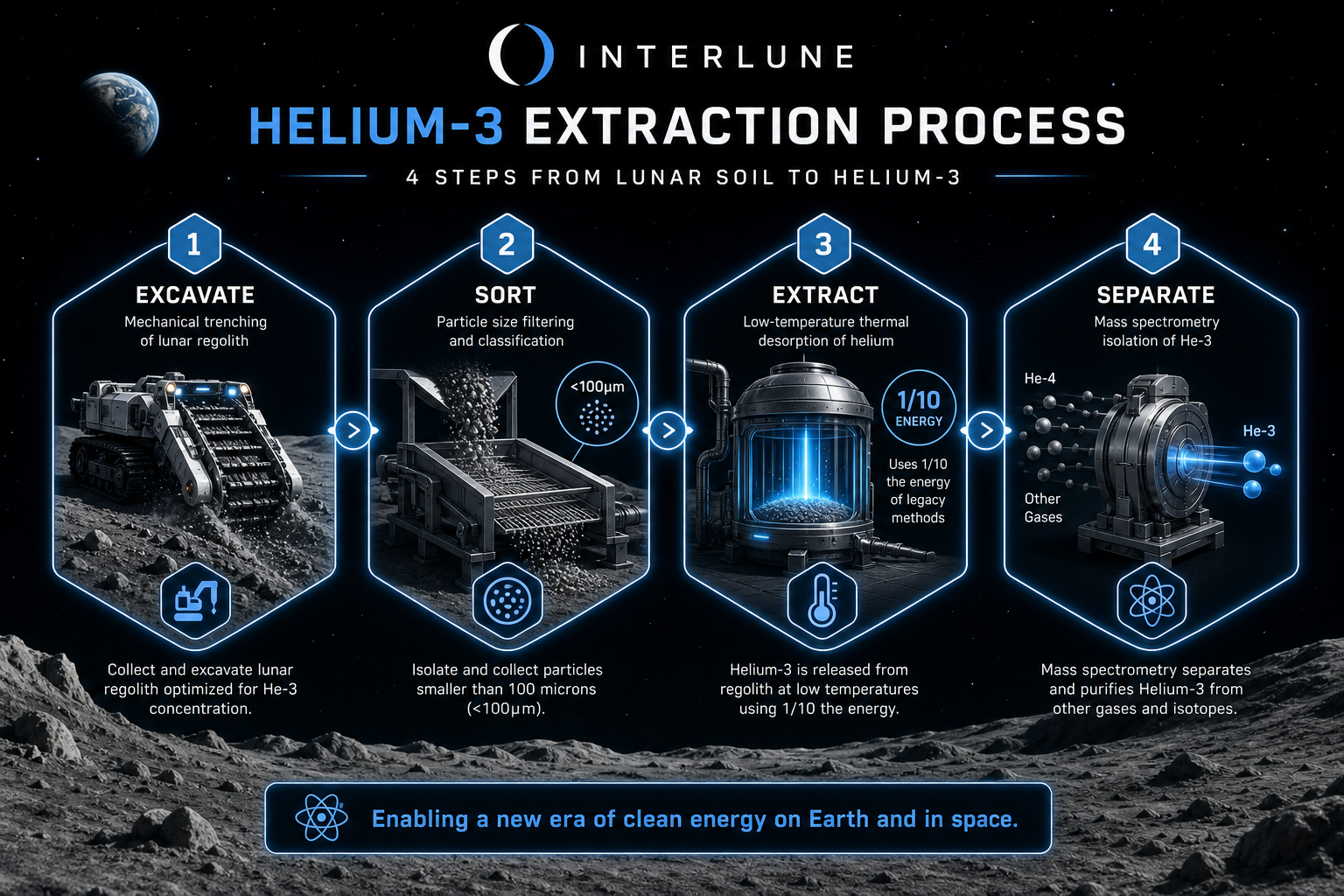 Interlune's 4-Step He-3 Extraction Process: Excavate → Sort → Extract → Separate
NASA Contract
- Amount: $6.9M (18 months, sole-source)
- Goal: Launch Prospect Moon payload in 2028
- Components: Robot arm, scoop, sorting device, mass spectrometer, mechanical/thermal processing unit
Customer Acquisition
| Customer | Use Case | Significance |
|---|---|---|
| U.S. DOE Isotope Program | Government research/medical | First non-Earth resource government purchase |
| Maybell Quantum | Quantum cooling | First commercial customer, delivery from 2029 |
2️⃣ Black Moon Energy — Traditional Stability
Company Overview
- CEO: David Warden
- Vision: Leading He-3 supplier by mid-2030s
Core Technology: Traditional Thermal Extraction
| Element | Description |
|---|---|
| Mining | Robot scouting and mining |
| Extraction | Solar thermal retort (600-900°C) |
| Storage | Gas compression into transport cylinders |
| Philosophy | "No new technology needed — recombination of existing tech" |
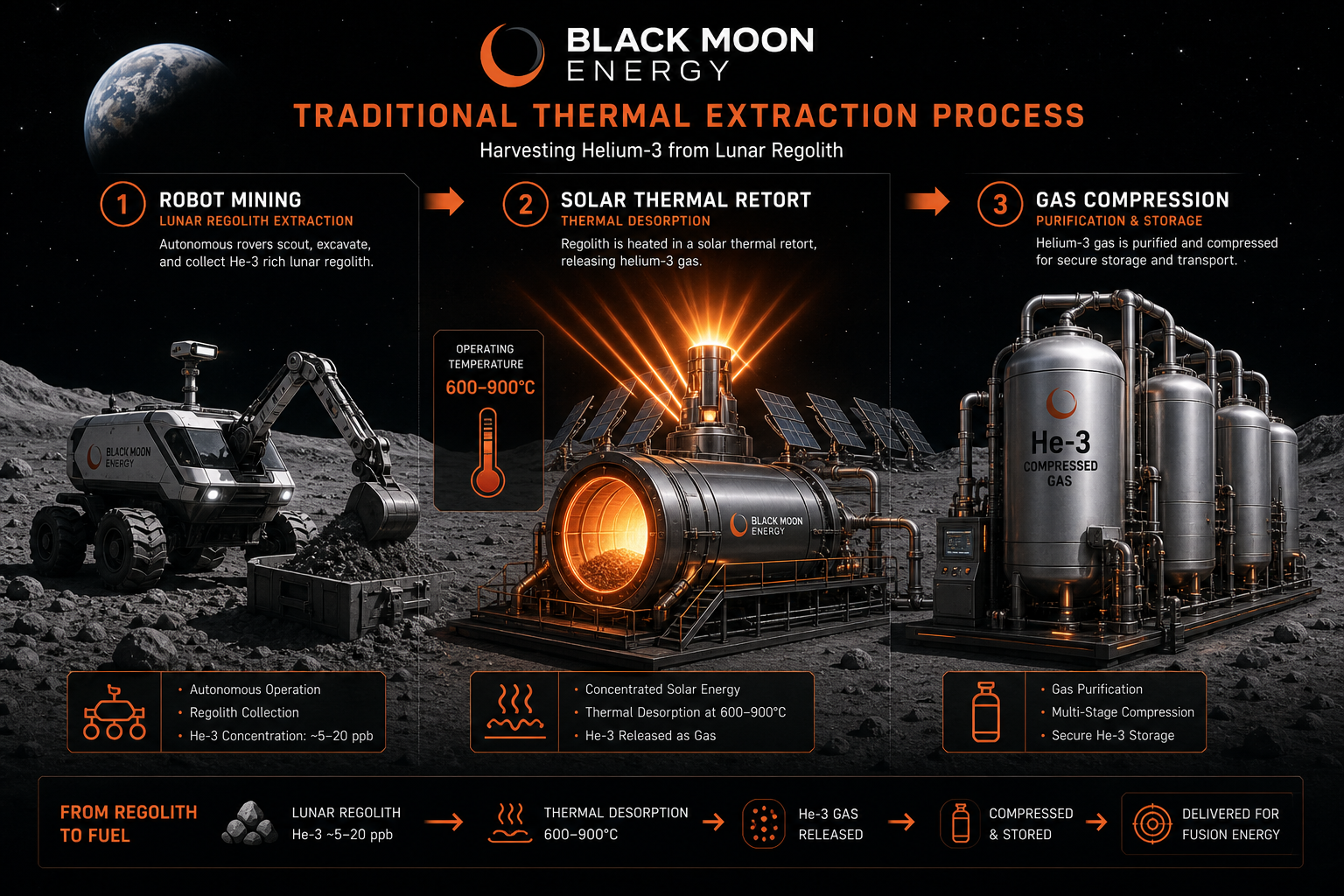 Black Moon Energy's Traditional Thermal Extraction: Robot Mining → Solar Heating (600-900°C) → Gas Compression Storage
Partnerships
- JPL (Jet Propulsion Laboratory): Robotic lunar exploration missions
- U.S. Department of Energy: Supply chain integration
Roadmap
- 2029: Scout and secure prime lunar zones
- Mid-2030s: Begin commercial production
3️⃣ Magna Petra — AI-Based Non-Destructive Innovation
Company Overview
- CEO: Jeffrey Max (veteran startup entrepreneur)
- Vision: Capture He-3 without destroying the environment
Core Technology: "Sifting & Tilling"
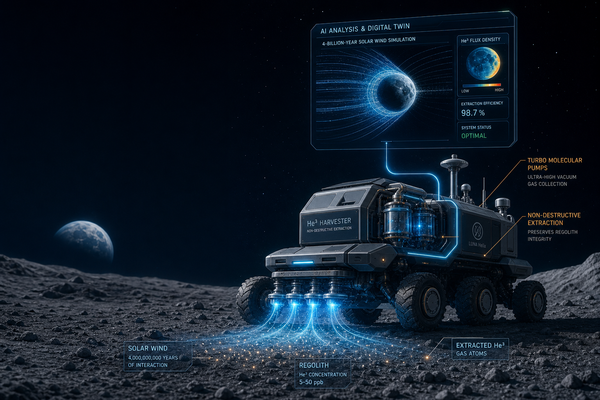
Unique Approach: Capture gaseous He-3 atoms without digging up soil
| Technology | Description |
|---|---|
| LunarPro™ AI | 4-billion-year solar wind simulation on Stanford supercomputer |
| Turbo Molecular Pumps | Transfer momentum from rotating blades to gas molecules |
| Mass Spectrometer | Space-environment mass analyzer |
| Pressurized Containment | Pressurized storage vessel + outgassing separation |
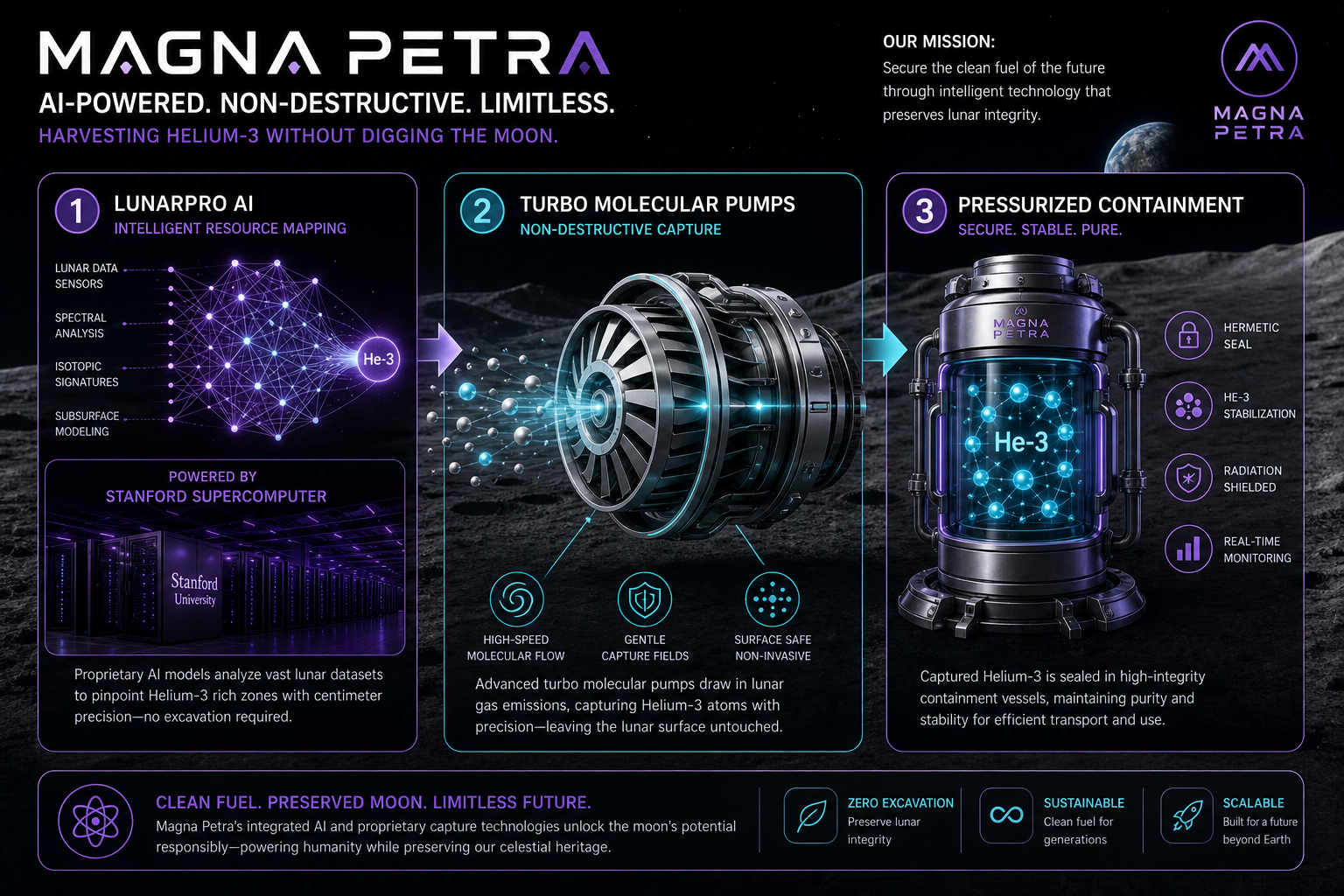 Magna Petra's AI-Based Non-Destructive He-3 Capture: LunarPro™ AI Simulation → Turbo Molecular Pump Gas Capture → Pressurized Containment
Partnerships
- ispace (Japan): AI robotics
- Stanford University: Supercomputing simulation
2025 Plans
- Deploy multispectral chip-ra to lunar south pole
- Precision exploration of He-3 deposits
🔬 In-Depth Technology Comparison
Energy Efficiency
Energy Consumption (Relative)

Black Moon Energy  ████████████████████████████████████████  100%
Interlune          ████                                       10%
Magna Petra        ██  (theoretical)                           ~5%
Extraction Mechanism
| Company | Temperature | Mechanism | Advantages | Disadvantages |
|---|---|---|---|---|
| Interlune | Low temp (~200°C?) | Mechanical vibration + heating | Proven efficiency, NASA support | Exact temperature undisclosed |
| Black Moon Energy | 600-900°C | Solar thermal retort | High technology maturity | High energy consumption |
| Magna Petra | Room temp (theoretical) | Mechanical capture | Environmentally friendly | Technology unproven |
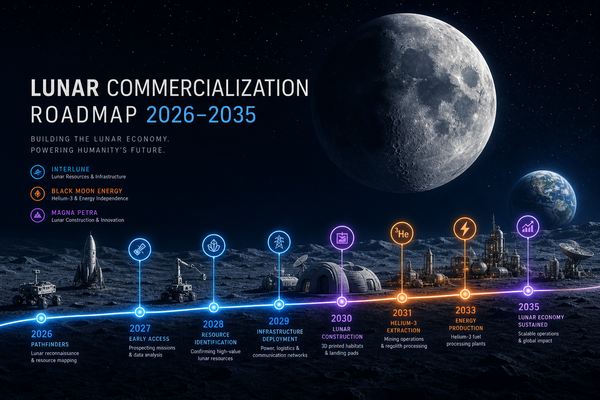
💰 Commercialization Roadmap Comparison
2026 ──┬── Interlune: Tech validation, Zero-G testing
       ├── Black Moon Energy: Robot development
       └── Magna Petra: AI simulation, chip-ra development

2028 ──┬── Interlune: 🚀 Prospect Moon launch (NASA)
       ├── Black Moon Energy: Exploration prep
       └── Magna Petra: Chip-ra deployment

2029 ──┬── Interlune: Commercialization begins (Maybell Quantum)
       ├── Black Moon Energy: 🚀 Scout mission
       └── Magna Petra: Tech validation

Mid-2030s ──┬── Interlune: Mass production?
            ├── Black Moon Energy: Commercialization begins
            └── Magna Petra: Commercialization?
🎯 Key Data
| Indicator | Interlune | Black Moon Energy | Magna Petra |
|---|---|---|---|
| NASA Funding | $6.9M | JPL Partnership | None |
| Key Partners | Vermeer, Astrolab, NASA | JPL, DOE | ispace, Stanford |
| Customers Secured | DOE, Maybell Quantum | DOE | None |
| Extraction Temperature | Low temp | 600-900°C | Room temp (theoretical) |
| Commercialization Target | 2029 | Mid-2030s | TBD |
🔮 Conclusion: Who Will Mine the Moon's He-3 First?
Interlune is furthest ahead with its NASA contract and proven technology. If Prospect Moon succeeds in 2028, it will create a precedent for commercialization.
Black Moon Energy takes a conservative but stable approach, increasing long-term survival probability.
Magna Petra is the most innovative but riskiest bet. If its non-destructive method is proven, it could be a game-changer.
However, all these companies operate under one precondition — D-³He aneutronic fusion reactors must be commercialized. When that day will come, no one knows.
In the next post, we will conduct a deep-dive analysis of the leader Interlune's Prospect Moon technology.
📚 References
-
Interlune — "Excavate, Sort, Extract, and Separate" https://www.interlune.space/blog/excavate-sort-extract-and-separate-interlune-core-intellectual-property
-
Interlune — Press Release (Excavator Prototype) https://www.interlune.space/press-release/space-resources-company-interlune-unveils-full-scale-prototype
-
SpaceNews — "Interlune wins NASA contract" https://spacenews.com/interlune-wins-nasa-contract-for-helium-3-extraction-payload/
-
Black Moon Energy — Official Website https://blackmoon.energy/
-
Magna Petra — "AI and Robotics in Helium-3 Extraction" https://magnapetra.com/the-role-of-ai-and-robotics-in-helium-3-extraction/
Series Guide: - Previous post: Moon Surface Mining 101: From ISRU to Helium-3 - Full series list: Moon Mining Tech Blog Series
Written by: lunarpulse_ Published: 2026-05-18 Tags: #moon-mining #helium-3 #interlune #black-moon-energy #magna-petra #space-resources