Moon Surface Mining 101: From ISRU to Helium-3
In April 2026, NASA's Artemis 2 splashed down in the Pacific, opening a new chapter in crewed lunar exploration. But Artemis 2 was not just a space voyage. It was the dawn of a new industry: Moon Surface Mining.
The Moon has water ice. Buried in the Permanently Shadowed Regions (PSRs) near the lunar poles, the exact quantity is still uncertain, but estimates range in the hundreds of millions of tons. This water becomes drinking water, oxygen, and rocket propellant. Given the cost of shipping from Earth, producing water on the Moon is an economic imperative.
This is the core of ISRU — In-Situ Resource Utilization.
NASA's ISRU Priorities
NASA has established the following priorities for lunar resource utilization:
| Priority | Resource | Extraction Tech | Use Case | Status |
|---|---|---|---|---|
| #1 | Water Ice | Mining + heating/filtration | Drinking water, oxygen, rocket propellant (H₂/O₂) | Artemis Base Camp core goal |
| #2 | Oxygen/Metals (Regolith) | Electrolysis, thermal reduction | Construction materials, life support | Technology validation |
| #3 | Helium-3 (He-3) | Thermal extraction, mechanical processing | Fusion fuel, quantum cooling | Early commercialization |
Why Water Ice Is Priority #1
Sending 1 kg of water from Earth to the Moon costs millions of dollars. Mining ice at the lunar south pole costs near zero by comparison. Water can be electrolyzed into oxygen and hydrogen — the perfect combination for rocket propellant. Propellant produced on the Moon could become a refueling station for Mars-bound spacecraft.
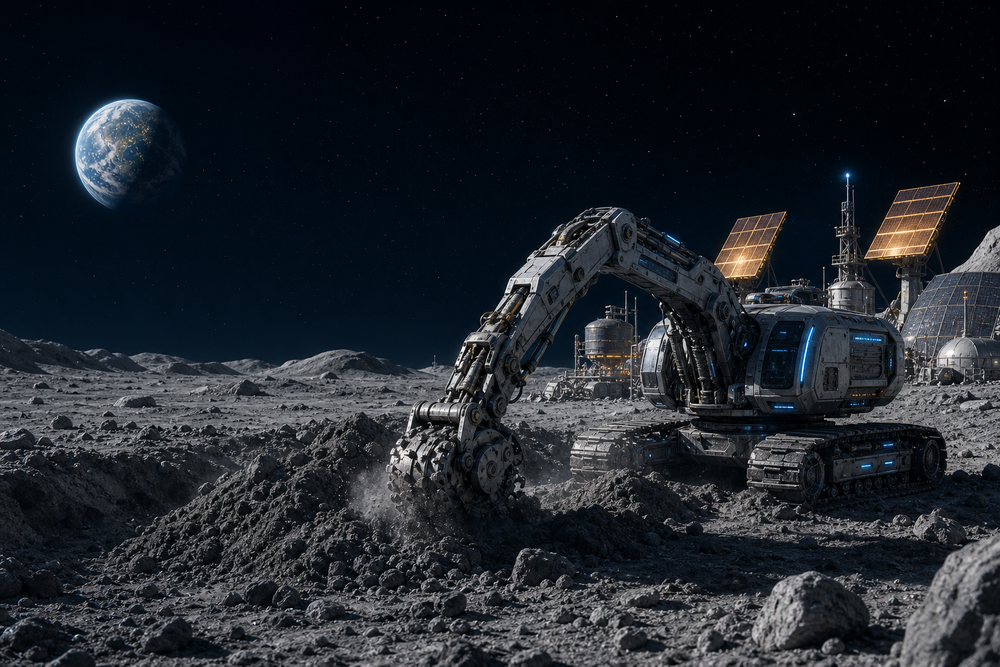
Core Hardware: Robots That Dig the Moon
RASSOR (Regolith Advanced Surface Systems Operations Robot)
- Developer: NASA Kennedy Space Center
- Form: Compact dual-bucket excavator robot
- Feature: Cylindrical bucket drums on both sides scrape and collect lunar surface material
- Purpose: Regolith excavation and transport
- Innovation: High excavation efficiency per unit weight, capable of climbing slopes
IPEx (Infrastructure Pilot Excavator)
- Developer: NASA
- Form: Bulldozer + dump truck hybrid
- Feature: Large-scale soil movement, autonomous/semi-autonomous operation
- Purpose: ISRU pilot facility construction
- Significance: Proof of concept that robots, not humans, can build lunar infrastructure
Interlune Excavator (Private Sector)
- Developer: Interlune + Vermeer Corporation
- Form: Continuous trencher-type
- Throughput: 100 metric tons per hour
- Feature: Commercial heavy equipment technology adapted for lunar environment
- Purpose: Large-scale regolith processing for Helium-3 extraction
CLPS Program: Private Sector Lunar Landings
NASA's Commercial Lunar Payload Services (CLPS) program provides private companies with opportunities to explore the lunar surface:
| Company | Country | Key Mission/Payload | Status |
|---|---|---|---|
| Intuitive Machines | USA | Nova-C lander (IM-1, IM-2) | IM-1 completed (2024) |
| ispace | Japan | HAKUTO-R M1, M2, TENACIOUS rover | M1 completed, M2 planned |
| Astrobotic | USA | Peregrine lander | In development |
| Lunar Outpost | USA | MAPP rover | In development |
| Firefly Aerospace | USA | Blue Ghost lander | In development |
Why Private Sector?
When NASA develops directly, costs are 10× higher. CLPS is a model where NASA becomes the customer and private companies provide the service. Intuitive Machines' IM-1 successfully landed near the lunar south pole — a historic first for private lunar landings.
Regolith: The Infinite Potential of Lunar Soil
The regolith covering the lunar surface is not just dust. It contains 40–45% oxygen, 5–15% iron, and various metals — a composite resource.
Regolith Utilization Technologies
| Technology | Description | Use Case | Developer |
|---|---|---|---|
| Molten Salt Electrolysis | Melt regolith and separate oxygen with electricity | Life support, propellant | NASA, ESA |
| Hydrogen Reduction | Use hydrogen to reduce metal oxides | Iron, aluminum, titanium | Multiple research labs |
| Microwave Sintering | Solidify soil with microwaves | Construction materials, radiation shielding | ESA (RegoLight) |
| 3D Printing | Use regolith as printing material | Base structures, roads | NASA, ESA |
ESA's RegoLight Project
The European Space Agency (ESA) is developing technology to make bricks from lunar soil through its RegoLight project. By heating regolith to 1,200°C with microwaves, dust sinters into solid blocks. These blocks can be used for lunar base walls, radiation shielding, and even roads.
"If you bring 1 kg of material from Earth to the Moon, it costs millions of dollars. Regolith is a resource given for free." — ESA Engineer
Helium-3: The Moon's Dream Fuel
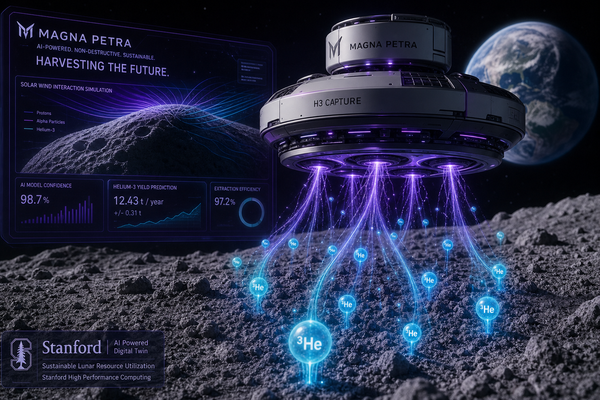
Regolith holds another surprise — Helium-3 (He-3). A rare isotope deposited on the lunar surface by solar wind over 4 billion years.
Why Helium-3?
- Fusion Fuel: The D-³He reaction is aneutronic fusion, producing almost no neutrons. No radioactive waste, and direct conversion to electricity is possible.
- Quantum Cooling: Essential for ultra-low temperature physics experiments.
- Scarcity: Almost none exists on Earth, but the Moon holds hundreds of thousands of tons.
He-3 Concentration
| Location | Concentration | Significance |
|---|---|---|
| Sunlit regions | 1.4–15 ppb | Apollo sample average: 11.8 ppb |
| Polar permanently shadowed regions | ~50 ppb | 5× higher |
ppb = parts per billion. Only a few milligrams of He-3 are extracted per ton of soil.
Current Challenges
He-3 extraction is still in its early stages. As of 2026, three pioneering companies are entering with different technological approaches. Their comparison will be covered in the next post.
Key Data Summary
| Metric | Value | Source |
|---|---|---|
| Estimated lunar south pole water ice | 600 million tons | LRO (Lunar Reconnaissance Orbiter) |
| Regolith oxygen content | 40–45% (by mass) | Apollo sample analysis |
| Regolith iron content | 5–15% | NASA |
| He-3 concentration (sunlit) | 1.4–15 ppb | Apollo samples |
| He-3 concentration (polar) | ~50 ppb | Lunar Prospector |
| Earth→Moon water transport cost | ~$1M+/kg | NASA estimate |
| He-3 estimated value | ~$20M+/kg | Interlune report |
Conclusion: The Moon Is Humanity's Next Frontier
The Artemis program is not just about going to the Moon. It is about building infrastructure to live, work, and produce on the Moon. As ISRU technology matures, the Moon will become the launchpad for Mars exploration, the hub for space resource mining, and perhaps the birthplace of humanity's first space economy.
In the next post, we will compare the technologies of three companies extracting the Moon's dream fuel, Helium-3: Interlune, Black Moon Energy, and Magna Petra.
References
- NASA — Artemis Program Overview
https://www.nasa.gov/wp-content/uploads/2020/12/artemis_plan-20200921.pdf - NASA — RASSOR Excavator
https://www.nasa.gov/centers/kennedy/engineering/development/rassor.html - NASA — IPEx (Infrastructure Pilot Excavator)
https://www.nasa.gov/infrastructure-pilot-excavator/ - ESA — RegoLight Project
https://www.esa.int/Enabling_Support/Space_Engineering_Technology/RegoLight - The Guardian (Apr 2026) — Lunar prospectors
https://www.theguardian.com/news/ng-interactive/2026/apr/01/lunar-prospectors-the-businesses-looking-to-mine-the-moon
Written by: lunarpulse_
Published: 2026-05-18
Tags: #moon-mining #ISRU #space-resources #Artemis #lunar-exploration